
Managing Max Capacities — Belgrave–Gembrook Services
Overview
This guide explains how to adjust maximum passenger capacities for Belgrave–Gembrook services in CustomLinc. There are two separate procedures depending on which capacity you need to change — read the overview below before making any adjustments.
Key Concepts: Manifests and Legs
In CustomLinc, a manifest represents the overall service (e.g. the 11:00 Bel-Lak-Gem / 15:05 Gem-Lak-Bel service). It appears as a green highlighted row in the Manifests view. Within each manifest, individual legs represent each segment of that journey — for example, Belgrave to Lakeside, or Lakeside to Gembrook. Legs appear as indented grey rows beneath the manifest.
 Changing capacity at the manifest level flows down and updates the relevant legs automatically. However, the Belgrave – Gembrook Allocation (Return) leg is a special product and must be adjusted separately using a different procedure.
How Capacity is Structured
Each leg on a Belgrave–Gembrook service has a total capacity of 176 passengers, made up of two components:
| Component | Capacity | Notes |
|---|---|---|
| Bel - Lak & Lak - Gmb Return / single-journey passengers | 120 | Covers Bel–Lak, Lak–Gem, and return equivalents |
| Belgrave – Gembrook Allocation (Return) | 56 | Full return journey product; seats are reserved via Allocation Groups |
| Total per leg | 176 |
Note: The 56 Belgrave–Gembrook Return passengers are already counted within each leg's 176-seat capacity. Adjusting the Return allocation changes how many of those 176 seats are reserved for that product specifically.
Quick Reference Guide
| What you want to change | Where to right-click | Key settings | Extra step? |
|---|---|---|---|
| Bel - Lake & Lake - Gmb Return or single-journey capacity (Bel–Lak, Lak–Gem, Gem–Lak, Lak–Bel) |
Green manifest row | Set max Pax to… | No — legs update automatically |
| Belgrave–Gembrook Return capacity (typically 56) |
Belgrave – Gembrook Allocation (Return) leg row | Set max Pax to… and Set Allocation on Allocation Groups | Yes — set Allocation Group to match |
Part A — Adjusting the Main Manifest Capacity
Use this procedure to change the capacity for general and single-journey passengers. This affects the four main legs: Belgrave–Lakeside, Lakeside–Gembrook, Gembrook–Lakeside, and Lakeside–Belgrave.
Do not manually edit these individual legs — changing the manifest will update them automatically.
Steps
Important Notes
-
Always right-click on the green manifest row, not an individual leg. Right-clicking a leg will only modify that single leg & will stop that leg getting updated max capacities via the manifest.
- This procedure does not affect the Belgrave–Gembrook Allocation (Return) leg. That must be adjusted separately — see Part B below.
Part B — Adjusting the Belgrave–Gembrook Return Allocation
Use this procedure to change the capacity for the Belgrave – Gembrook Allocation (Return) product — the full return journey product, typically set to 56 seats. This procedure includes an extra step: you must also update the Allocation Group to match the new value, otherwise the seat reservation will be out of sync.
Steps
- In Sightseeing > Manifests, locate the relevant service and find the Belgrave – Gembrook Allocation (Return) row at the bottom of the manifest's legs.
- Right-click on the Belgrave – Gembrook Allocation (Return) leg row.
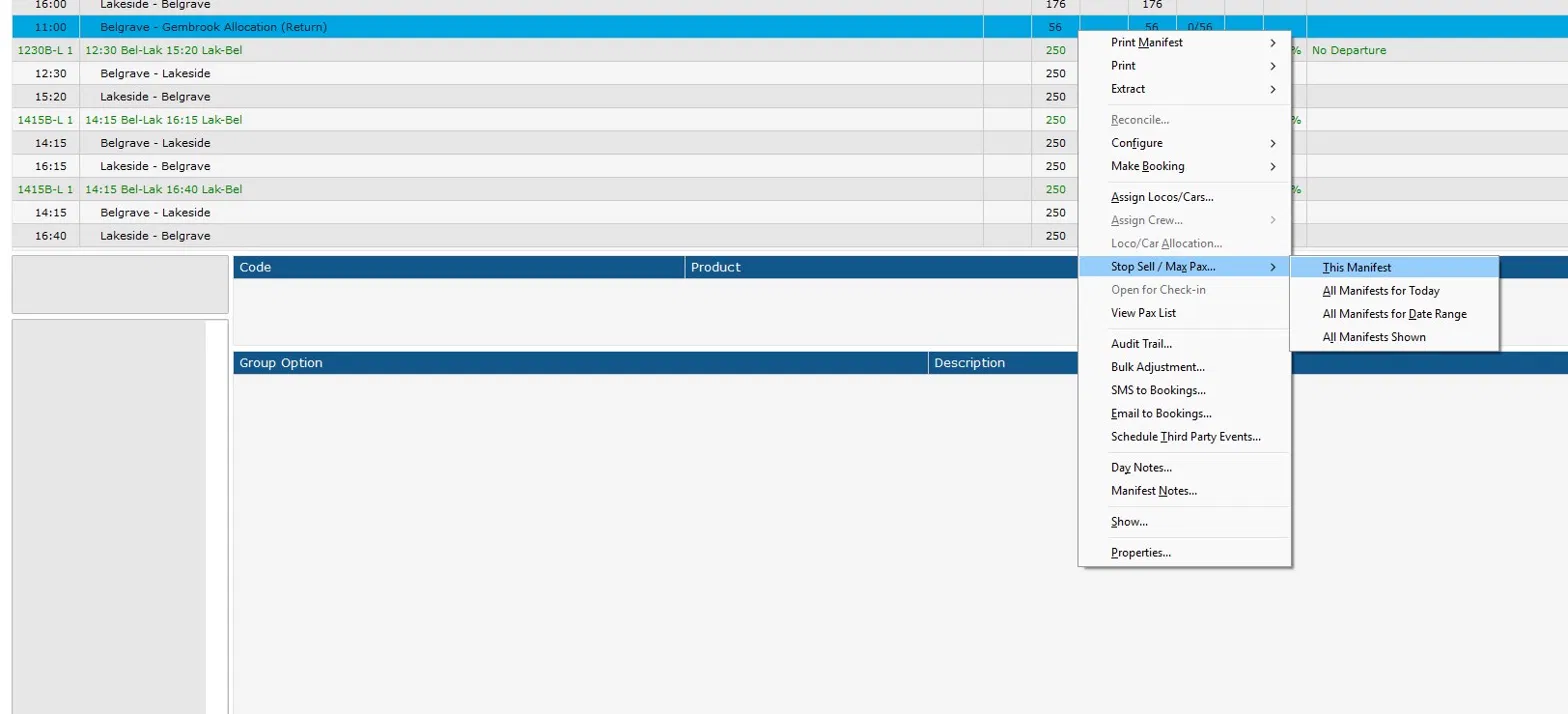
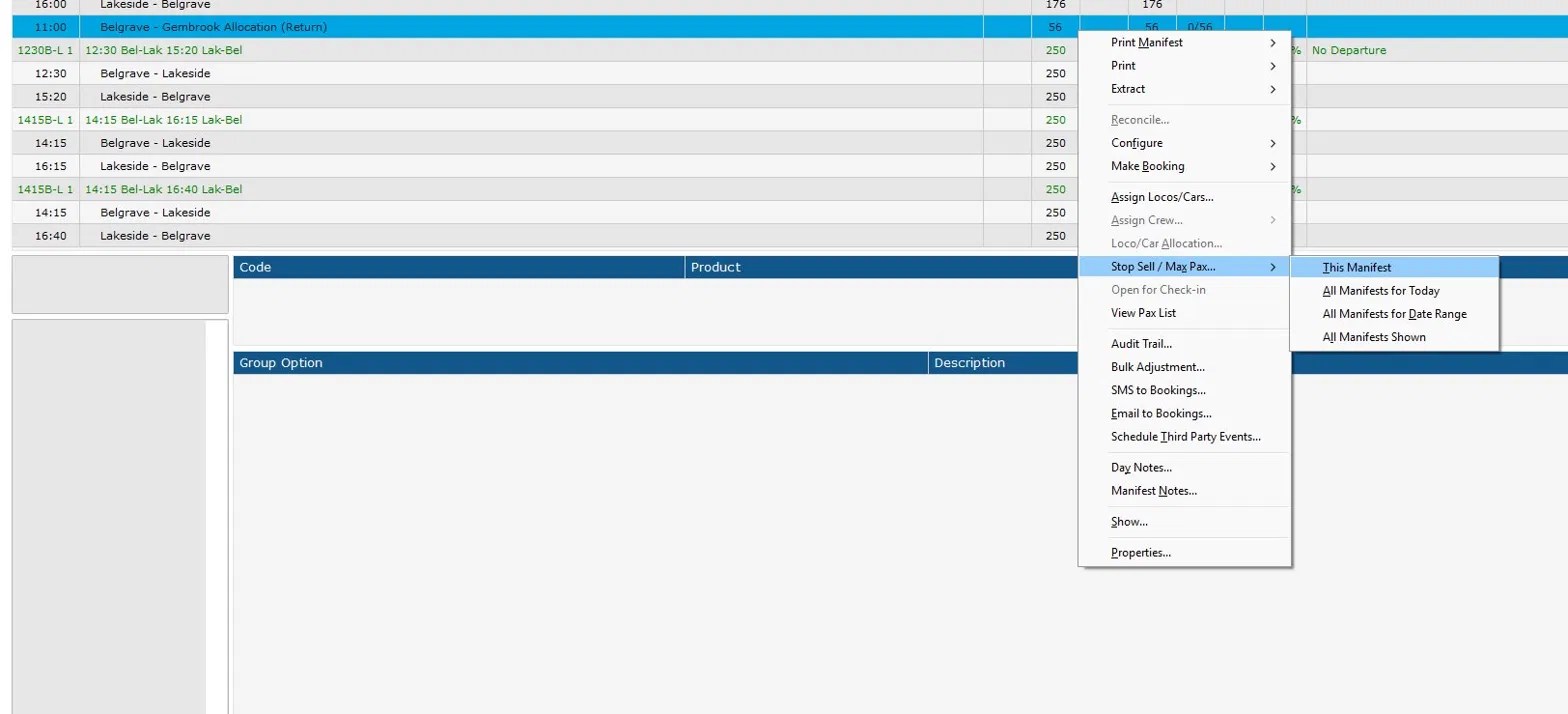
- Hover over Stop Sell / Max Pax… and select This Manifest.
- In the dialog:
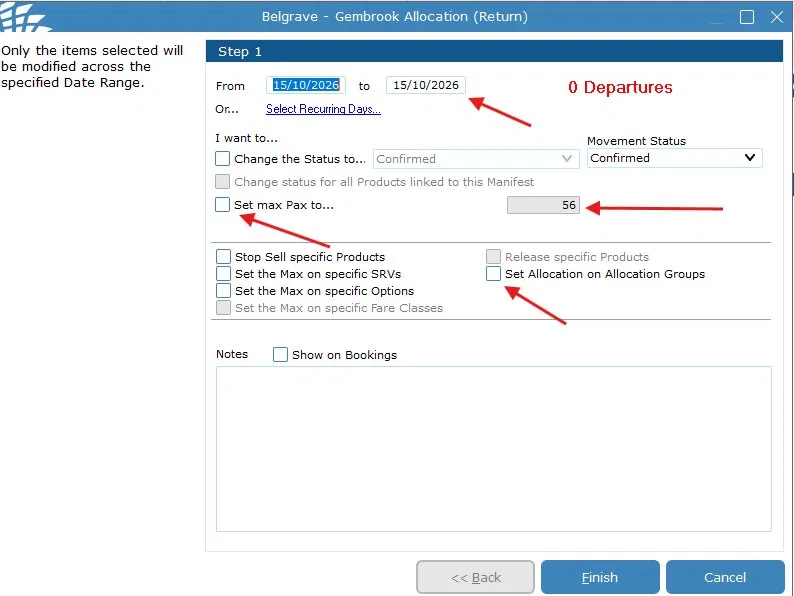
- Set the From and To date range, or use Select Recurring Days… as needed.
- Tick Set max Pax to… and enter the new capacity value.
- Tick Set Allocation on Allocation Groups — this is critical and must not be skipped.
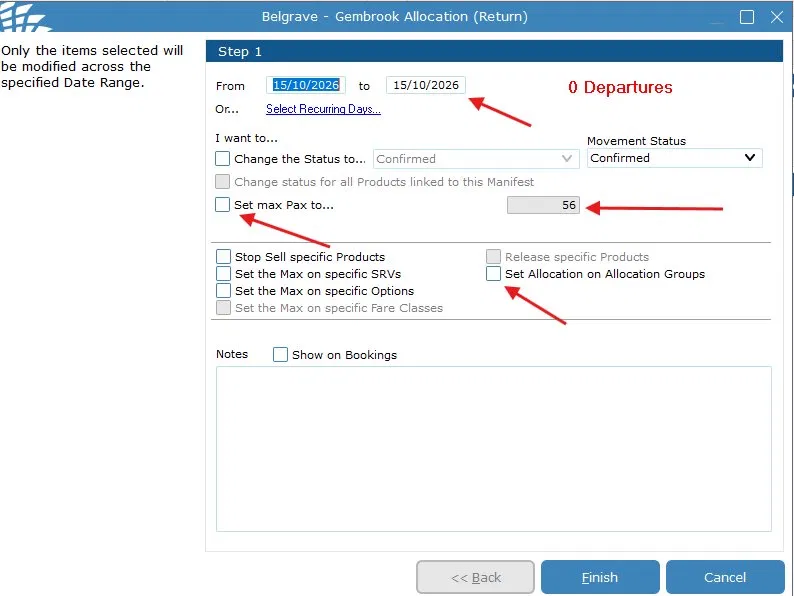
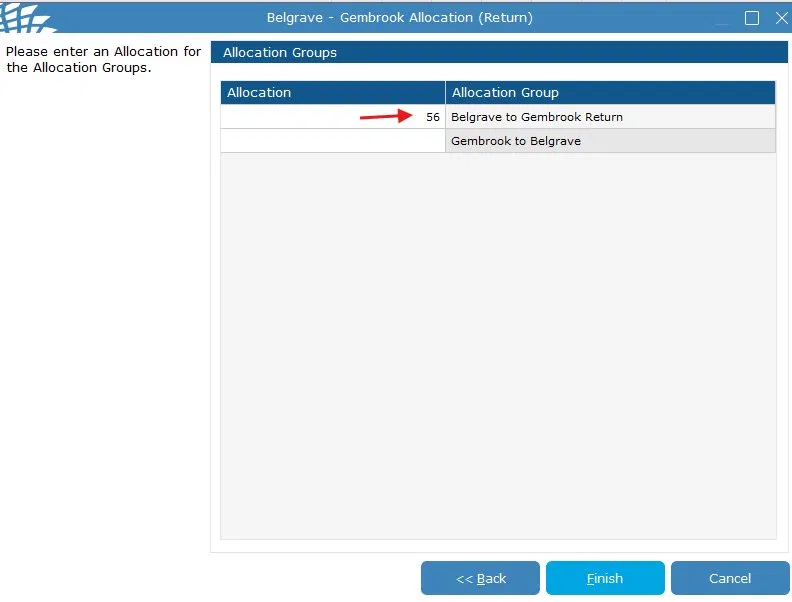
- Click Finish. The Allocation Groups screen will appear.
- On the Allocation Groups screen, find Belgrave to Gembrook Return and set its Allocation value to the same number entered for max Pax in the previous step.
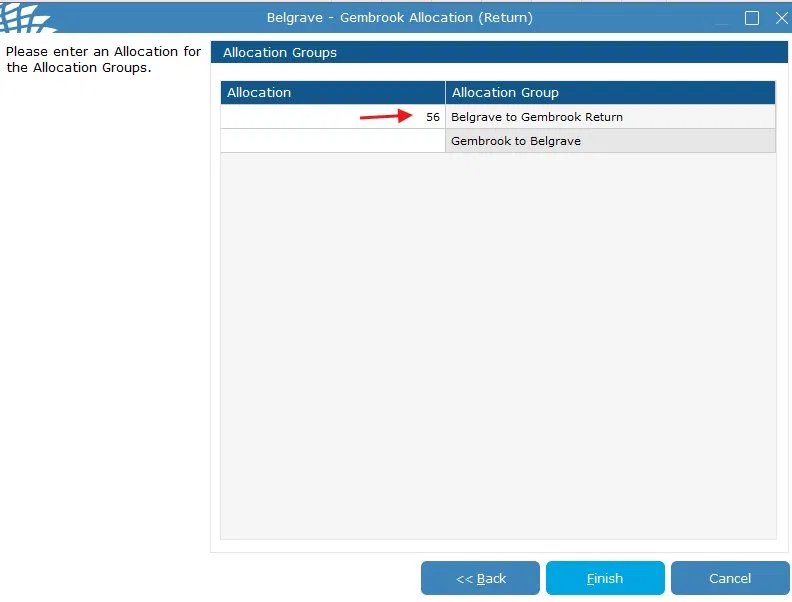
- Click Finish to save.
- Does the entire train capacity need to be increased because of this?
If yes, please also adjust the manifest accordingly see Part A.
An example of this would be an extra carriage being added to the carriage set specifically for Bel-Gmb.
Important Notes
-
The "Set Allocation on Allocation Groups" checkbox must always be ticked when changing this leg. Skipping it will cause a mismatch between the max Pax limit and the reserved seat allocation, which may result in overbooking.
- Only update the Belgrave to Gembrook Return allocation group. Leave Gembrook to Belgrave blank unless specifically instructed otherwise.
- This leg's capacity does not change automatically when you adjust the main manifest — both procedures must be performed independently if both values need updating.
Maintenance Notes
- Review and update capacities whenever rolling stock or service configurations change.
- Always verify leg capacity figures after making changes to confirm they have applied correctly.
- If the Allocation Group value and max Pax become mismatched, the system may accept bookings beyond the intended limit. Always tick "Set Allocation on Allocation Groups" for any Part B changes.
No comments to display
No comments to display